Unemployment Insurance Benefit Calculations: 26-Week Extension Impact
Advertisements
Unemployment insurance benefit calculations can become especially confusing when a worker receives severance pay after losing a job. Understanding payment amounts, benefit duration, and state-specific eligibility rules is essential for planning the months ahead.
In many parts of the United States, regular unemployment insurance can provide up to 26 weeks of temporary assistance. However, this limit varies by state, and receiving severance does not automatically establish eligibility for additional benefits.
This guide explains how unemployment insurance benefit calculations work, how severance payments may affect claims, and what workers should understand about possible benefit extensions.
How Unemployment Insurance Benefit Calculations Work
Unemployment Insurance, commonly called UI, provides temporary financial assistance to qualifying workers who become unemployed under circumstances covered by state law.
The amount a claimant receives generally depends on previous earnings, the applicable state's benefit formula, and the maximum weekly payment established by that state.
Because unemployment insurance benefit calculations differ across jurisdictions, there is no single nationwide formula that determines every worker's weekly payment.
Understanding the Base Period
Most states evaluate earnings from a defined base period, commonly the first four of the five most recently completed calendar quarters.
This earnings history helps the unemployment agency determine whether an applicant meets monetary eligibility requirements and how much the weekly benefit may be.
Some states offer alternative base-period calculations when applicants do not qualify through the standard method. Workers should consult their state agency for the applicable rules.
What Determines the Weekly Benefit Amount?
States use different calculation methods, including formulas based on earnings in particular quarters or average wages during the base period.
After applying the relevant formula, the state may also impose minimum and maximum weekly payment limits.
For reliable unemployment insurance benefit calculations, applicants should compare official earnings records with the monetary determination issued by their unemployment agency.
Understanding the Relationship Between Severance and Unemployment Benefits
Severance pay generally refers to compensation provided by an employer when an employee's job ends, although its structure and purpose can vary between agreements.
Some employers distribute severance through a single payment, while others provide periodic payments or compensation covering a specified period.
The interaction between severance and unemployment insurance benefit calculations depends largely on how the relevant state classifies these payments.
How Severance Can Affect an Initial Claim
In some states, severance may postpone unemployment payments or reduce benefits during particular weeks.
Other jurisdictions treat qualifying severance differently and may allow claimants to receive benefits without a reduction attributable to that payment.
Workers should report information requested by the state agency accurately and avoid assuming that receiving severance automatically prevents unemployment eligibility.
Payment Timing: The date severance is received may matter under state rules.
Payment Structure: Lump-sum and installment arrangements may receive different treatment.
State Regulations: Eligibility depends on the applicable unemployment insurance law.
Supporting Documents: Severance agreements can help agencies determine the nature of the payment.
Is Severance Considered Wages?
The treatment of severance as wages is not consistent across the United States.
For example, California generally excludes qualifying severance pay from wages for unemployment insurance purposes, while New York applies rules that may affect eligibility based on payment amounts and timing.
These differences make state-specific guidance essential when reviewing unemployment insurance benefit calculations after receiving a severance package.
What a 26-Week Benefit Extension Could Mean
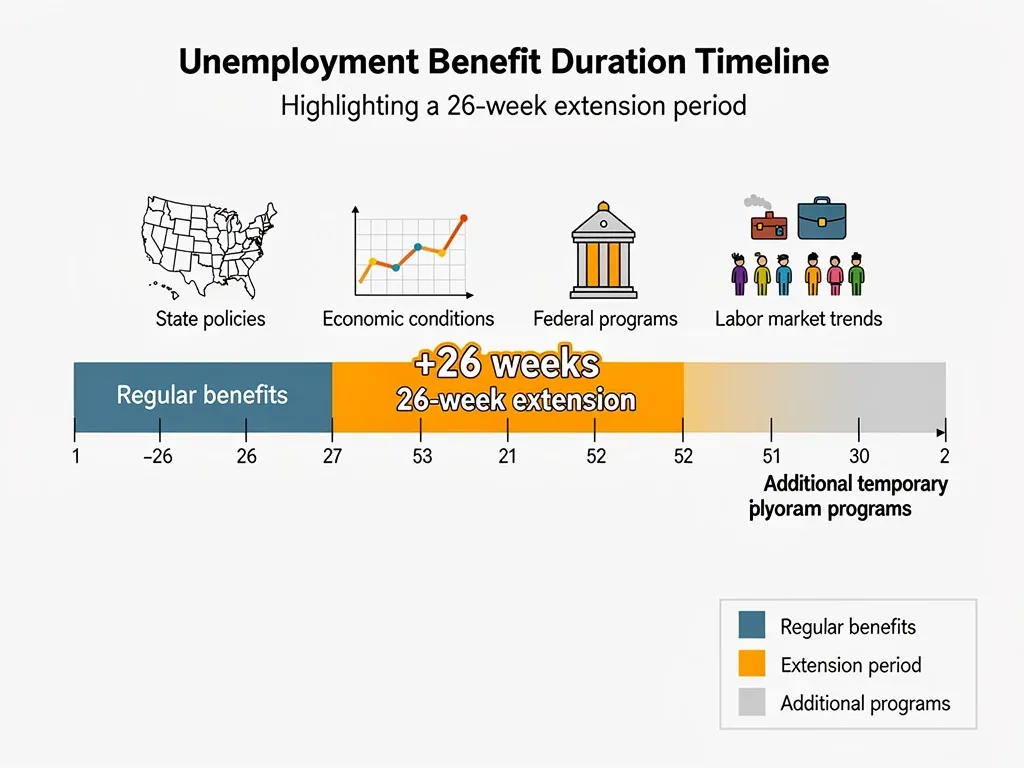
Many states ordinarily offer a maximum of approximately 26 weeks of regular unemployment insurance, although some provide fewer weeks.
A separate extension would increase the period of potential assistance for qualifying recipients, but no general nationwide rule automatically adds another 26 weeks to every claim.
Understanding this distinction is necessary before estimating total entitlement or incorporating expected payments into a household budget.
Regular Benefits and Extended Benefits Are Different
Regular unemployment benefits are administered under established state eligibility and payment rules.
The federal-state Extended Benefits program can become available when a state's unemployment conditions meet specified activation requirements.
Under the basic Extended Benefits framework, eligible claimants may receive up to 13 additional weeks, with up to 20 weeks possible under certain qualifying conditions.
How Extensions May Apply After Severance
A worker who received severance may eventually qualify for additional unemployment support if the applicable extension program is available and all requirements are satisfied.
However, the end of a severance payment period does not independently guarantee access to Extended Benefits.
Applicants must still satisfy the program's eligibility conditions, which can include exhaustion of regular benefits and continued compliance with work-search requirements.
Regular Benefits: Confirm the remaining entitlement on the original claim.
Extension Activation: Check whether the state currently offers Extended Benefits.
Severance Rules: Understand how payments are classified by the agency.
Ongoing Eligibility: Continue required certifications and employment searches.
Additional assistance may also depend on specific legislation, but proposed benefits should never be treated as approved payments until officially enacted and implemented.
Why 26 Weeks Does Not Automatically Become 52
Suppose a worker qualifies for 26 weeks of regular unemployment benefits. That does not establish eligibility for another 26 weeks after the regular entitlement ends.
If the basic Extended Benefits program becomes available and the claimant qualifies, up to 13 additional weeks could be payable under the applicable rules.
In that hypothetical situation, the combined maximum would be 39 weeks rather than 52. Actual benefits depend on state activation and individual entitlement.
State Differences in Unemployment Insurance Benefit Calculations
Each state administers its unemployment insurance program according to its own eligibility requirements, benefit formulas, and procedural rules.
Consequently, the same earnings history or severance arrangement may produce different outcomes in different jurisdictions.
Anyone researching unemployment insurance benefit calculations should prioritize official information from the state responsible for the claim.
Comparing Different State Approaches
California generally does not classify qualifying severance pay as wages for unemployment insurance purposes.
New York, by contrast, has rules under which dismissal or severance payments may affect eligibility depending on the amount received and the timing of the payments.
Workers in other states should not assume either approach applies to them. State labor departments provide the relevant current instructions.
Why Local Rules Matter for Benefit Extensions
Extended Benefits availability is linked to statutory conditions, including state unemployment measurements and applicable program provisions.
Therefore, an extension that is available in one state may not be operating in another during the same period.
State-specific verification helps prevent inaccurate expectations about how long unemployment insurance benefits will continue.
Applying for Unemployment Benefits After Receiving Severance
Workers who lose their jobs should review unemployment application instructions promptly rather than assuming they must wait until severance payments are exhausted.
In many situations, filing as soon as possible allows the state agency to determine eligibility and identify the correct treatment of any separation payments.
The application process normally requires employment details, earnings history, and accurate information concerning the circumstances of job separation.
Documents to Prepare Before Filing
Gathering employment and compensation records in advance can make it easier to complete an unemployment insurance application accurately.
Severance recipients should retain written agreements, payment statements, and any employer correspondence explaining the payment arrangement.
These documents may be important when the agency reviews monetary eligibility or determines how severance affects particular benefit weeks.
Employment Records: Employer names, employment dates, and job separation information.
Wage Information: Pay statements or other supporting earnings records.
Severance Agreement: Documentation showing payment terms and amounts.
Work Search Records: Evidence required for ongoing eligibility.
Weekly or Biweekly Certifications
After submitting an initial claim, applicants may be required to certify eligibility regularly to receive payments.
Certification questions can cover work performed, income received, availability for employment, and required job-search activities.
Missing deadlines or submitting inaccurate information can delay benefits or cause additional administrative problems.
Financial Effects of Extended Unemployment Benefits
Unemployment insurance can help eligible workers pay essential expenses during periods without regular employment income.
Additional benefit weeks, when available, may support household financial stability while claimants search for suitable positions.
However, the economic effects of benefit extensions depend on their structure, duration, funding, and the employment conditions present when they operate.
Supporting Household Expenses
Temporary assistance may help families cover housing costs, groceries, utilities, and necessary transportation expenses.
For severance recipients, coordinating payments from former employers with confirmed unemployment benefits can improve short-term budgeting.
Workers should build financial plans around approved amounts rather than assuming that potential extensions will automatically become available.
Potential Benefits for Local Economies
Unemployment payments may help maintain some consumer spending when households experience an unexpected reduction in earned income.
This spending can support local businesses during difficult labor market conditions, although the magnitude varies.
Economists also consider program costs and labor market effects when evaluating the broader consequences of extended unemployment assistance.
Common Challenges for Workers Receiving Severance
Severance arrangements can complicate unemployment claims when workers are uncertain about payment classifications or reporting requirements.
Confusion can also arise over benefit start dates, remaining entitlement, and whether an extension has actually been activated.
Reviewing official guidance and keeping accurate records can help applicants address these issues more effectively.
Avoiding Overpayments and Reporting Errors
An unemployment overpayment occurs when an agency determines that a claimant received benefits exceeding the amount legally payable.
Incorrect earnings reports or mistakes involving severance information may contribute to such determinations.
Applicants should carefully review agency notices and follow applicable appeal or repayment procedures when disagreements arise.
Planning Around Uncertain Benefit Dates
Processing times and payment schedules can vary according to individual claims and administrative conditions.
Workers should identify essential expenses, track available savings, and review confirmed benefit information before making financial commitments.
This approach is especially important when severance payments are expected to end before another employment opportunity becomes available.
Future Outlook for Unemployment Insurance Programs
Unemployment insurance policies may evolve through state legislation, federal actions, or changes in economic conditions affecting established programs.
Discussion of expanded benefits does not mean that a particular extension has been enacted or made available to all claimants.
Individuals following unemployment insurance benefit calculations should distinguish confirmed policy changes from proposals and general public discussions.
What Workers Should Monitor
Important developments include changes to state benefit formulas, maximum durations, monetary eligibility requirements, and Extended Benefits activation.
Claimants should also monitor official correspondence regarding work-search requirements and changes affecting their individual claims.
Reliable updates should come from the appropriate state unemployment agency or the U.S. Department of Labor.
Separating UI Rules From Other Assistance Programs
Unemployment Insurance is separate from Supplemental Security Income and other public assistance programs that use different eligibility criteria.
For example, policy discussions involving SSI asset limits and ABLE accounts do not establish unemployment insurance eligibility or benefit duration.
Understanding the difference between programs helps applicants avoid applying unrelated rules to unemployment insurance benefit calculations.
Practical Financial Planning for Severance Recipients
After a job separation, workers can begin by documenting severance amounts, essential monthly expenses, and other available resources.
Once an unemployment agency issues an eligibility determination, the confirmed weekly payment and remaining entitlement can be incorporated into a budget.
Possible extensions should be treated as uncertain until official program information and the claimant's eligibility are confirmed.
Creating a Payment Timeline
Record the dates of severance payments and compare them with necessary household expenses.
Review agency notices to determine the approved unemployment benefit amount and any restrictions affecting payment periods.
Keeping an organized timeline can help identify potential income gaps and support more realistic financial planning.
When to Request Additional Guidance

Workers with complicated severance agreements may benefit from contacting their state agency or obtaining qualified legal assistance.
This can be particularly useful when a claim is denied, payment classification is disputed, or an overpayment notice is issued.
Because rules and deadlines differ, applicants should follow the procedures provided for their particular state and claim.
Conclusion
Unemployment insurance benefit calculations depend on previous earnings, state regulations, and eligibility requirements that can differ substantially across the United States.
Receiving severance may affect unemployment payments in some states but does not automatically prevent every worker from qualifying.
Although 26 weeks is a common maximum for regular benefits, an additional 26-week extension is not automatic. Claimants should rely on confirmed state agency determinations when planning their finances.
Key Point | Brief Description |
|---|---|
Benefit Calculation | Weekly payments depend on state formulas, previous earnings, and eligibility requirements. |
Severance Impact | Severance may delay, reduce, or have no effect on unemployment benefits depending on state law. |
26-Week Extension | Additional 26-week payments are not automatic; the established Extended Benefits program may provide up to 13 or, under certain conditions, 20 extra weeks. |
State Variations | Benefit duration, severance treatment, and filing procedures differ across jurisdictions. |
Frequently Asked Questions on Unemployment Benefits
How are Unemployment Insurance Benefit Calculations performed?▼
Unemployment insurance benefit calculations generally use earnings recorded during a qualifying base period. Each state applies its own formula, minimum eligibility requirements, and maximum weekly payment limits. Workers should review the monetary determination issued by their state unemployment agency for the specific amount associated with their claim.
Does severance pay affect eligibility for a 26-week benefit extension?▼
Severance pay may influence ordinary unemployment eligibility depending on state law and the payment arrangement. However, a nationwide additional 26-week extension is not automatically available. Eligibility for any active Extended Benefits program depends on state conditions, individual entitlement, and continued compliance with applicable requirements.
What should severance recipients know about Unemployment Insurance Benefit Calculations?▼
Severance recipients should understand how their state classifies separation payments and follow all reporting instructions. Some states may reduce or delay unemployment payments, while others generally exclude qualifying severance from wages. Keeping complete documentation and filing according to official guidance can help prevent unnecessary complications.
How does a 26-week benefit extension provide support?▼
If a specific extension adding 26 weeks were legally authorized, it could provide additional payments to eligible workers. However, this should not be confused with the ordinary federal-state Extended Benefits program, which generally offers up to 13 additional weeks and up to 20 weeks under certain qualifying conditions. No universal 52-week entitlement should be assumed.
Where can I find state-specific information on Unemployment Insurance Benefit Calculations?▼
Visit the official unemployment insurance agency website for the state responsible for your claim. The U.S. Department of Labor also provides information about state programs and Extended Benefits. These sources explain filing requirements, monetary calculations, severance treatment, and applicable benefit duration rules.
Looking Ahead
The availability and duration of unemployment benefits can change in response to legislation, state rules, and qualifying economic conditions.
For severance recipients, accurate unemployment insurance benefit calculations require understanding both the original claim and any separately authorized extension.
Following official state notices, maintaining complete records, and planning around confirmed payments can help workers make more informed decisions while seeking new employment.