SSI Asset Limit Overhaul: Protect Up to $100,000 in ABLE Accounts
Advertisements
The ABLE account SSI rules 2026 include an important expansion that allows more people with disabilities to qualify for tax-advantaged ABLE savings accounts.
The biggest change is not a new $100,000 exemption, but an increase in the disability-onset age requirement from before age 26 to before age 46.
Meanwhile, the general SSI resource limits remain $2,000 for an individual and $3,000 for a couple, making ABLE accounts particularly important for eligible beneficiaries who want to save.
What Actually Changed for ABLE Accounts in 2026?
Beginning January 1, 2026, a person may qualify for an ABLE account if the qualifying disability or blindness began before the individual's 46th birthday.
Before 2026, the condition generally had to begin before age 26, excluding many people whose disabilities developed later in adulthood.
The new age threshold substantially expands the population potentially eligible to open and use an ABLE account while preserving the program's existing tax and public-benefit protections.
The Age Expansion Comes From SECURE 2.0
The change was established by the SECURE 2.0 Act of 2022, which amended the age requirement for ABLE eligibility effective with tax year 2026.
The law did not wait until 2026 to be enacted; rather, lawmakers established the future effective date several years in advance.
This distinction is important because the 2026 development is an eligibility expansion, not a newly announced overhaul of the entire Supplemental Security Income program.
The $100,000 SSI Exclusion Is Not New
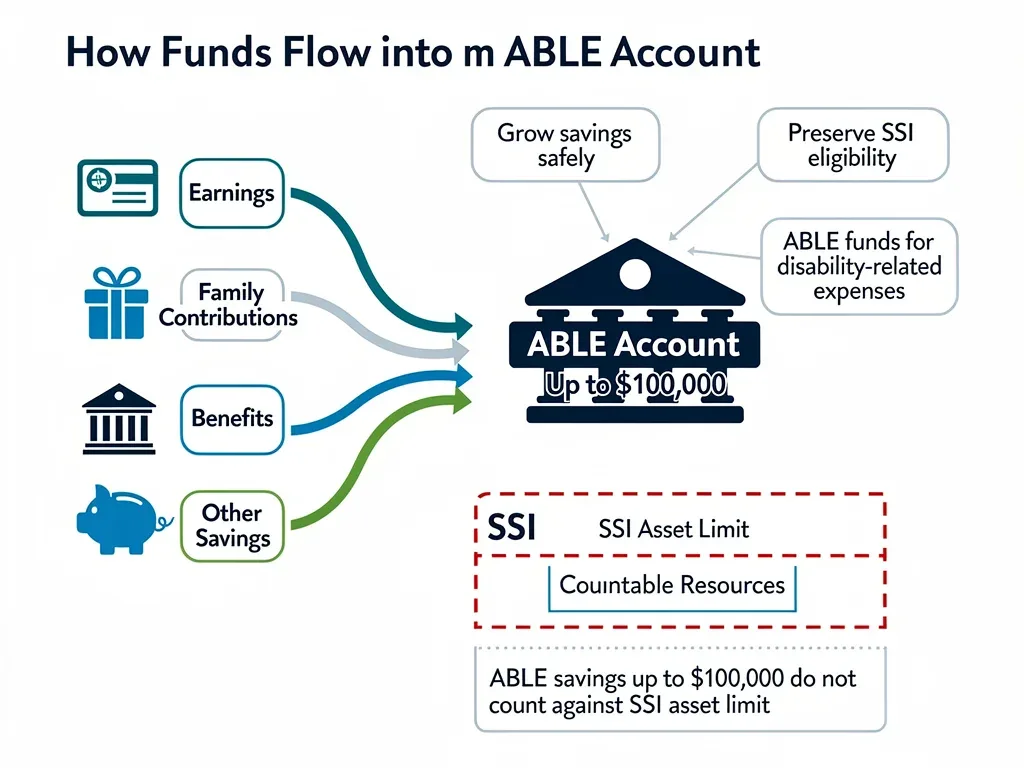
SSI has long excluded up to and including $100,000 held in a qualifying ABLE account when determining the beneficiary's countable resources.
This protection was built into the federal ABLE framework created in 2014 rather than introduced as a new rule in 2026.
The account therefore allows eligible individuals to hold substantially more than the ordinary SSI resource limit without automatically losing monthly benefits.
The Rule Works Alongside the Regular SSI Resource Limit
The first $100,000 held in the ABLE account is excluded, while other countable resources generally remain subject to ordinary SSI rules.
For example, money in a regular checking or savings account can still count toward the $2,000 individual resource limit unless another exclusion applies.
An ABLE account therefore does not eliminate SSI resource rules; it creates a specific federal exclusion for qualifying funds held inside the account.
SSI Resource Limits Remain $2,000 and $3,000
For 2026, the SSI resource limit remains $2,000 for an eligible individual and $3,000 for an eligible couple.
Those statutory amounts have remained unchanged for decades, even as the federal SSI payment amount and other program thresholds have increased over time.
That makes resource exclusions such as the ABLE account particularly significant for beneficiaries trying to build savings without exceeding SSI limits.
Not Every Asset Counts Toward the Limit
SSI does not count every item a person owns as a resource because federal rules contain several exclusions depending on the type and use of the asset.
Certain homes, vehicles, burial funds and other resources may receive different treatment depending on the beneficiary's circumstances and applicable SSA rules.
Beneficiaries should therefore avoid assuming that their total net worth is automatically identical to the amount SSA considers countable resources.
Who Can Qualify for an ABLE Account in 2026?
A person may qualify when blindness or disability began before age 46 and the individual meets one of the recognized federal eligibility pathways.
This can include people receiving SSI, Social Security Disability Insurance or certain other Social Security disability benefits based on a condition beginning before age 46.
People who are not currently receiving those benefits may also qualify through the disability-certification process when the applicable requirements are satisfied.
Receiving SSI Is Not the Only Route to Eligibility
An ABLE account is not limited exclusively to people currently receiving monthly Supplemental Security Income payments.
A person may qualify through SSDI or through an appropriate disability certification showing that the qualifying condition began before age 46.
This broader structure allows some individuals to use ABLE accounts even when their income or other circumstances make them ineligible for SSI cash benefits.
Only One ABLE Account Is Generally Allowed
A designated beneficiary generally may have only one ABLE account administered through a qualified state ABLE program.
Opening multiple qualifying accounts does not allow a beneficiary to multiply the SSI exclusions or annual contribution limits available under federal law.
SSA rules provide limited treatment for certain transfers and account corrections, but the normal framework is based on one account per eligible beneficiary.
You May Not Be Limited to Your Home State's Plan
ABLE programs are established and administered through states or qualifying state arrangements, but plan structures vary across the country.
Some states manage their own programs, while others participate in partnerships or use outside administrators to provide account services.
Eligible individuals should compare fees, investment choices, state tax treatment and account features before selecting a program where interstate enrollment is permitted.
The Basic 2026 Contribution Limit Is $20,000
The aggregate basic annual contribution limit for ABLE accounts is $20,000 for tax year 2026 under the federal rules.
This amount applies to total qualifying contributions made by the beneficiary and other contributors rather than giving every contributor a separate $20,000 allowance.
Family members, friends and other permitted contributors can generally help fund the account, subject to the overall annual contribution limits.
Some Workers Can Contribute More
Certain employed ABLE beneficiaries can make additional contributions beyond the standard annual limit under the ABLE to Work provisions.
The extra amount is generally limited to the lesser of the beneficiary's compensation for the year or the applicable poverty-line amount for a one-person household.
Additional restrictions apply, including rules related to employer contributions to certain retirement plans, so eligibility for the extra contribution should be checked carefully.
The $100,000 Threshold Is Not the Account's Maximum Balance
A frequent misunderstanding is that an ABLE account must stop growing once its balance reaches $100,000.
The $100,000 figure is specifically important for SSI resource treatment, while each state ABLE program can establish a substantially higher overall account-balance limit.
Consequently, an ABLE account can potentially hold more than $100,000 even though the portion above that amount receives different treatment under SSI rules.
Only the Amount Above $100,000 Becomes Countable
When an ABLE account exceeds $100,000, SSA does not suddenly count the entire account against the beneficiary's SSI resource limit.
Instead, the agency counts the portion above $100,000 when determining whether the beneficiary has exceeded the applicable resource threshold.
This distinction can materially affect eligibility calculations for people who have accumulated significant balances inside their accounts.
What Happens When an ABLE Account Exceeds $100,000?
If the amount above $100,000 causes the beneficiary's countable resources to exceed the SSI limit, monthly SSI cash payments can be suspended.
The beneficiary does not necessarily lose eligibility permanently, and regular SSI payments can resume when the ABLE-related excess no longer causes resources to exceed the limit.
SSA applies special rules to these ABLE-related suspensions that differ from ordinary excess-resource situations involving non-ABLE assets.
Medicaid Can Continue During an ABLE-Related Suspension
When the excess resources are attributable to the ABLE balance above $100,000, Medicaid eligibility can continue while SSI cash payments are suspended.
The beneficiary must otherwise remain eligible, but federal law specifically protects Medicaid in this type of ABLE-related resource suspension.
This is an important difference from some situations involving excessive non-ABLE resources, where Medicaid linked to SSI eligibility may also be affected.
Non-ABLE Resources Still Require Careful Monitoring
A large ABLE balance does not protect ordinary money held in checking, savings, investment or other countable accounts outside the ABLE structure.
If non-ABLE countable resources independently exceed the applicable SSI limit, the beneficiary may face different suspension and Medicaid consequences.
Beneficiaries should therefore monitor both the ABLE account and assets outside the account rather than focusing only on the $100,000 threshold.
The Source of Excess Resources Matters
SSA distinguishes between excess resources caused by the portion of an ABLE account above $100,000 and excess resources caused by other assets.
This distinction determines whether special indefinite SSI suspension protections and continued Medicaid treatment can apply.
Financial planning should therefore consider where funds are held, not merely the beneficiary's combined dollar amount across every account.
ABLE Funds Can Cover Qualified Disability Expenses
ABLE funds can be used for qualified disability expenses that relate to the beneficiary's blindness or disability and support health, independence or quality of life.
Examples can include education, housing, transportation, employment training, assistive technology, personal support services and healthcare-related expenses.
The category is broader than emergency medical spending and is designed to address many costs associated with living with a disability.
Qualified Withdrawals Can Be Tax-Free
Earnings inside an ABLE account can grow without current federal income taxation when the account follows applicable federal requirements.
Distributions used for qualified disability expenses are generally tax-free, making the account useful for both public-benefit planning and long-term savings.
Nonqualified withdrawals may create tax consequences, so account owners should maintain appropriate records showing how distributed funds were used.
Housing Expenses Require Special SSI Attention
Housing is considered a qualified disability expense for federal ABLE tax purposes, but SSI resource treatment can require additional care after a distribution.
SSA treats retained housing distributions differently from certain other qualified disability-expense distributions when funds remain unspent into a later month.
Beneficiaries planning large rent, mortgage or other housing payments should understand these timing rules before withdrawing funds substantially earlier than necessary.
Timing Can Affect Resource Treatment
An ABLE distribution itself is generally not treated as income by SSA because it represents a conversion of one resource into another form.
However, money retained after withdrawal can receive different resource treatment depending on whether it was designated for housing or another qualified disability expense.
This makes careful timing and recordkeeping especially important when ABLE funds are used for major planned expenditures.
Depositing SSI Into an ABLE Account Does Not Erase Income Rules
SSI and Social Security payments can generally be deposited into an ABLE account when program and representative-payee requirements are followed.
However, placing money into an ABLE account does not automatically cause income that was countable for SSI purposes to become excluded income.
The distinction between income treatment and resource treatment is essential because the ABLE exclusion primarily changes how qualifying account balances are treated as resources.
ABLE Accounts Are Not a Way to Hide Countable Income
A worker cannot generally make countable earnings disappear for SSI calculations merely by transferring those earnings into an ABLE account.
SSA first applies its normal income rules and then applies resource rules to qualifying funds once they are held in the ABLE account.
Other work incentives may apply in certain circumstances, but they operate under separate requirements from the ABLE resource exclusion.
ABLE Accounts Can Support Employment Goals
Qualified disability expenses can include employment training, job support, transportation and assistive technology connected with working or preparing for work.
This allows beneficiaries to use savings for expenses that may increase independence or make employment more practical.
ABLE to Work can further expand contribution capacity for some employed account owners who satisfy the applicable requirements.
Employment Does Not Automatically End ABLE Eligibility
An individual does not lose an ABLE account simply because they begin working or their earnings increase after the account is established.
SSI cash benefits and other means-tested programs can respond to earnings under their own rules, while the ABLE account has separate eligibility and tax provisions.
Beneficiaries who work should evaluate earnings, SSI work incentives and ABLE contributions together rather than treating each system in isolation.
An ABLE Account Can Support Long-Term Planning
The ability to protect a substantial account balance can help eligible individuals prepare for major expenses that are difficult to fund under ordinary SSI resource limits.
Examples may include accessible transportation, education, assistive equipment, home modifications and other qualifying costs expected in future years.
The account can also provide an emergency reserve without requiring the beneficiary to keep every dollar inside an ordinary countable savings account.
The Goal Is Flexibility, Not Unlimited Savings
ABLE accounts still operate under annual contribution limits, state account limits, qualified-expense rules and other federal requirements.
The SSI exclusion also has the specific $100,000 threshold, meaning very large balances require additional monitoring for beneficiaries receiving SSI.
The account is therefore best understood as a specialized planning tool rather than an unlimited shelter from every public-benefit financial rule.
ABLE Accounts and Special Needs Trusts Are Different
Some beneficiaries and families also use special needs trusts when planning for assets that could otherwise affect means-tested public benefits.
An ABLE account and a trust can have different contribution rules, control structures, permitted uses, costs and estate-recovery implications.
One arrangement does not automatically replace the other, and some families use both depending on the beneficiary's needs and financial circumstances.
Professional Advice Can Matter for Larger Assets
Inheritance, legal settlements, property sales and other large transfers can create complex SSI and Medicaid consequences that exceed ordinary ABLE account planning.
An attorney or financial professional experienced in disability-benefit planning can help evaluate the interaction among trusts, ABLE accounts and public programs.
This is particularly important before transferring significant assets because correcting an improperly structured transaction later may be difficult.
State ABLE Programs Can Differ
Federal law establishes the basic tax and SSI framework, but individual ABLE programs can differ in fees, investment choices and administrative features.
Some states also provide state-level tax benefits for contributions, while others do not offer the same deductions or credits.
Eligible individuals should compare programs rather than assuming every ABLE account provides an identical experience simply because federal eligibility rules are the same.
State Maximum Balances Can Also Differ
The overall account-balance ceiling is generally linked to limits established by the program and can be far higher than the $100,000 SSI exclusion.
This is another reason not to confuse the federal SSI threshold with the maximum amount an ABLE program allows inside the account.
A beneficiary who does not receive SSI may also evaluate a large ABLE balance differently because the $100,000 SSI resource rule may not affect monthly cash benefits.

Medicaid Payback Rules May Apply After Death
ABLE planning should also consider what can happen to remaining funds after the designated beneficiary dies.
Under federal rules, a state may make a claim for reimbursement of certain Medicaid benefits after outstanding qualified disability expenses are paid.
State practices and applicable deductions can vary, so families should review the rules of the specific ABLE program before relying on the account for estate planning.
An ABLE Account Is Not the Same as an Inheritance Account
Because Medicaid reimbursement provisions can apply, leaving a large permanent balance inside an ABLE account may have different consequences from other estate-planning arrangements.
The account's primary purpose is to support the beneficiary's qualified disability expenses during life rather than maximize wealth transferred to heirs.
Families planning substantial estates should evaluate ABLE accounts alongside other disability-planning tools rather than assuming one account solves every objective.
The 2026 Change Could Expand ABLE Access Significantly
Raising the disability-onset threshold to age 46 allows many adults who were previously too old at onset to qualify for the program.
This can include people who developed qualifying disabilities in their late twenties, thirties or early forties and were excluded under the former age-26 requirement.
The reform expands access without changing the basic principle that the qualifying disability must have begun before a specified age.
People Previously Ineligible Should Recheck the Rules
A person who was denied access solely because the disability began after age 25 may now fall inside the expanded 2026 threshold.
Eligibility still requires satisfying the other federal criteria, so reaching the new age standard does not automatically qualify every applicant.
People who previously dismissed ABLE accounts because of the old age rule may nevertheless have a strong reason to review eligibility again in 2026.
The SSI Asset Limit Was Not Overhauled in 2026
Descriptions of a broad “SSI asset limit overhaul” can create the impression that Congress raised the general $2,000 and $3,000 resource thresholds.
That did not occur in 2026, and the Social Security Administration continues to publish those same statutory resource limits.
The major ABLE-related change is expanded eligibility based on disability-onset age, while the existing $100,000 exclusion continues to operate as before.
Proposals and Advocacy Should Not Be Confused With Current Law
Advocacy organizations and lawmakers have discussed modernizing SSI resource limits and other program rules for many years.
Legislative proposals can receive substantial attention without becoming effective law, particularly when bills remain pending or fail to complete the legislative process.
Beneficiaries should therefore rely on current SSA rules when making financial decisions rather than assuming proposed reforms have already taken effect.
ABLE Account SSI Rules 2026 at a Glance
The ABLE account SSI rules 2026 preserve the longstanding $100,000 SSI exclusion while expanding access to a much larger group of people.
The ordinary SSI resource limit remains unchanged, but the ABLE annual basic contribution cap increased to $20,000 for the 2026 tax year.
The table below separates the genuine 2026 changes from provisions that were already part of the ABLE framework before this year.
Know Which Limits Refer to Which Rule
The $2,000 SSI resource limit, $100,000 ABLE exclusion and $20,000 annual contribution limit refer to three different rules and should not be treated interchangeably.
The state program's overall account-balance ceiling is another separate figure that can substantially exceed the SSI exclusion threshold.
Understanding these distinctions makes it easier to plan without accidentally applying one program limit to an unrelated financial decision.
Key Rule | 2026 Position |
|---|---|
ABLE Disability-Onset Age | Qualifying blindness or disability must have begun before age 46, up from the former age-26 threshold. |
SSI Individual Resource Limit | $2,000 in countable resources. |
SSI Couple Resource Limit | $3,000 in countable resources. |
ABLE SSI Exclusion | Up to and including $100,000 of the ABLE balance is excluded for SSI resource purposes. |
Basic Annual ABLE Contributions | $20,000 total for 2026, before any qualifying ABLE to Work additional contribution. |
Balance Above $100,000 | Only the excess becomes countable; SSI cash can be suspended if resources exceed the applicable limit. |
Medicaid During ABLE-Only Suspension | Can continue when the SSI suspension results from excess resources attributable to the ABLE balance. |
Frequently Asked Questions About ABLE Accounts and SSI
Did SSI increase its general asset limit in 2026?
No. The federal SSI resource limits remain $2,000 for an individual and $3,000 for a couple in 2026.
Is the $100,000 ABLE exclusion new in 2026?
No. The exclusion has been part of the federal ABLE framework since the ABLE Act was enacted in 2014.
What changed for ABLE eligibility in 2026?
The qualifying disability-onset age increased from before age 26 to before age 46 beginning January 1, 2026.
How much can generally be contributed to an ABLE account in 2026?
The basic aggregate annual contribution limit is $20,000, with some employed beneficiaries eligible to contribute additional amounts under ABLE to Work.
Can an ABLE account have more than $100,000?
Yes. The $100,000 figure is an SSI resource-exclusion threshold rather than necessarily the state ABLE program's maximum account balance.
What happens to SSI when the ABLE account goes above $100,000?
Only the excess above $100,000 counts as a resource, and SSI cash benefits can be suspended if that excess causes total countable resources to exceed the applicable limit.
Does Medicaid stop when SSI is suspended because of an ABLE balance?
Not when the suspension results from ABLE-related excess resources and the person otherwise remains eligible; special federal rules can allow Medicaid to continue.
Can SSI payments be deposited into an ABLE account?
Yes, subject to applicable account and representative-payee requirements, although depositing benefits does not change how income was originally treated under SSI rules.
Can an ABLE account pay for housing?
Yes. Housing can qualify as a disability expense, although retained housing distributions can receive special resource treatment under SSI rules.
Can family members contribute to an ABLE account?
Yes. Family members and other permitted contributors can contribute, but their contributions count toward the account's overall annual contribution limit.
Can a person have more than one ABLE account?
Generally no. A designated beneficiary is normally limited to one qualifying ABLE account, except for specific transfer or correction situations.
Are withdrawals always tax-free?
Distributions are generally tax-free when used for qualified disability expenses; nonqualified distributions can have different federal tax consequences.
Conclusion
The most important change in the ABLE account SSI rules 2026 is the expansion of eligibility to people whose qualifying disability or blindness began before age 46.
The $100,000 SSI resource exclusion remains a longstanding ABLE protection, while ordinary SSI resource limits continue at $2,000 for individuals and $3,000 for couples.
Beneficiaries should distinguish contribution limits, SSI exclusions and state account limits carefully and use current SSA and IRS guidance when planning significant deposits or withdrawals.