2026 Catch-Up Contribution Rules: Maximize Retirement Benefits
Advertisements
The 2026 catch-up contribution rules allow eligible workers aged 50 and older to increase workplace retirement savings. The IRS permits a standard $8,000 catch-up contribution, an enhanced $11,250 amount for ages 60 through 63, and requires Roth catch-up contributions for certain workers whose 2025 wages exceeded $150,000.
The 2026 catch-up contribution rules introduce important considerations for Americans aged 50 and older who want to strengthen their workplace retirement savings.
Under SECURE 2.0, eligible workers can contribute additional amounts to certain employer-sponsored plans, while specific higher-income participants must follow new Roth contribution requirements.
Understanding the updated IRS limits, age-based opportunities, and tax implications can help employees make informed decisions about retirement contributions throughout 2026.
Understanding the New 2026 Catch-Up Contribution Rules
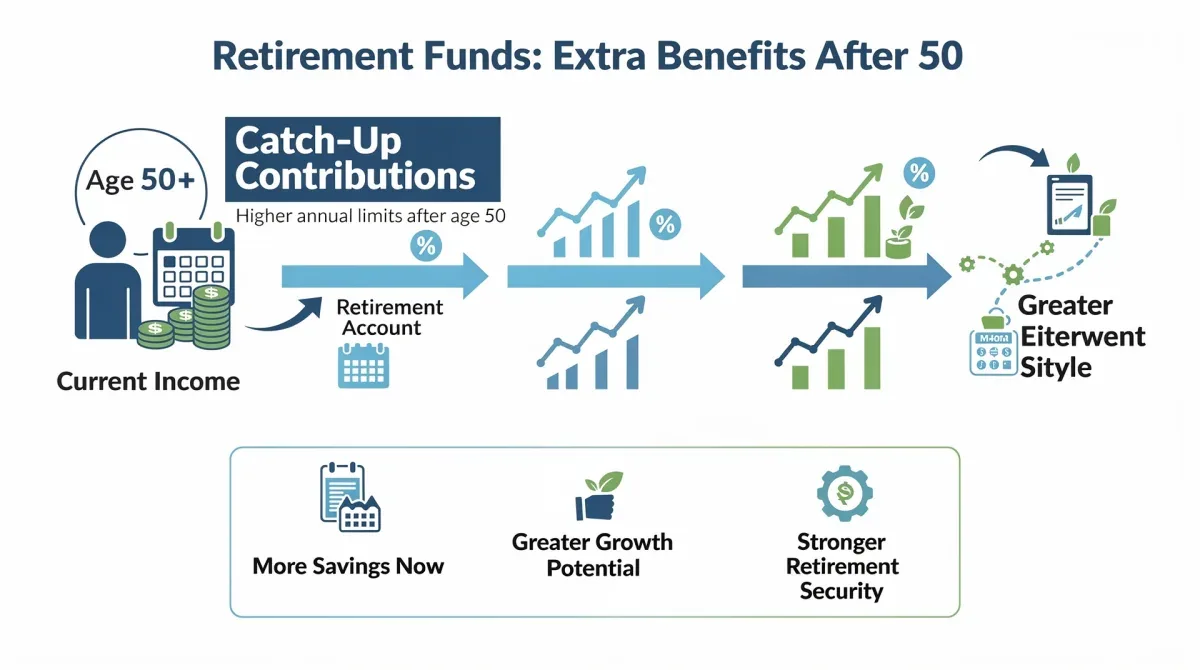
Catch-up contributions allow eligible workers aged 50 and older to contribute more to qualifying retirement plans than the standard annual employee contribution limit.
These additional contributions can be particularly useful for individuals approaching retirement who want to allocate more of their current earnings toward long-term savings.
The 2026 catch-up contribution rules combine updated IRS contribution limits with provisions introduced under the SECURE 2.0 Act of 2022.
Key Legislative Background and Intent

The SECURE 2.0 Act introduced several retirement plan changes intended to expand savings opportunities and modify certain requirements for employer-sponsored arrangements.
Among its provisions are enhanced catch-up contribution limits for people aged 60 through 63 and mandatory Roth treatment for certain higher-income employees.
Although the enhanced age-based limit began in 2025, the Roth catch-up requirement for qualifying higher-income participants became effective in 2026.
Which Retirement Plans Are Covered?
Catch-up contribution provisions apply to several workplace arrangements, including eligible 401(k), 403(b), governmental 457(b), and federal Thrift Savings Plan accounts.
However, eligibility and contribution limits depend on the type of plan, applicable federal rules, and whether the employer's arrangement permits particular contributions.
Workers reviewing the 2026 catch-up contribution rules should confirm their plan's provisions before assuming every available contribution option applies to them.
Mandatory Roth Treatment for Higher-Income Workers
One significant development for 2026 concerns the required tax treatment of catch-up contributions made by certain employees with higher previous-year wages.
Qualifying participants must direct their catch-up contributions into designated Roth accounts rather than using the traditional pre-tax treatment for those additional amounts.
This requirement is an important part of the 2026 catch-up contribution rules, particularly for workers who previously relied on pre-tax catch-up savings.
Who Must Make Roth Catch-Up Contributions?
For 2026, the relevant threshold is more than $150,000 in 2025 FICA wages from the employer sponsoring the retirement plan.
Employees exceeding that amount generally must make applicable catch-up contributions as designated Roth contributions, subject to the relevant rules and exceptions.
The threshold concerns prior-year wages from the sponsoring employer, not necessarily total household income or income received from every possible source.
Why the $145,000 Threshold Is Outdated
The original SECURE 2.0 legislation established a $145,000 wage threshold that was subject to cost-of-living adjustments for subsequent years.
For the 2026 Roth catch-up requirement, the IRS increased the relevant prior-year wage threshold to $150,000 through its annual adjustment guidance.
Therefore, articles explaining the 2026 catch-up contribution rules should use the $150,000 amount instead of presenting $145,000 as the current threshold.
How Roth Contributions Differ From Pre-Tax Contributions
Traditional pre-tax contributions generally reduce current taxable income, while designated Roth contributions are made with income that has already been taxed.
Qualified withdrawals from Roth accounts can be tax-free when applicable distribution requirements are satisfied, potentially providing flexibility during retirement.
However, the preferable tax treatment depends on individual circumstances, future tax rates, available cash flow, and the rules governing particular distributions.
2026 Retirement Contribution Limits Explained
The IRS establishes annual contribution limits for workplace retirement plans and adjusts selected amounts according to applicable statutory requirements.
For 2026, the basic employee elective deferral limit for most 401(k), 403(b), governmental 457(b), and federal Thrift Savings Plan arrangements is $24,500.
Understanding these figures is essential when applying the 2026 catch-up contribution rules and determining how much additional saving may be permitted.
Standard Catch-Up Contributions for Age 50 and Older
For 2026, eligible participants who reach age 50 by the end of the calendar year can generally contribute an additional $8,000.
Combined with the standard $24,500 employee contribution limit, this creates a potential employee contribution total of $32,500 for the applicable age groups.
These figures apply to qualifying plans and do not mean every employee automatically has sufficient compensation or plan eligibility to contribute the maximum.
Enhanced Catch-Up Limits for Ages 60 Through 63
Employees who turn 60, 61, 62, or 63 during 2026 may qualify for a higher catch-up contribution limit of $11,250.
When combined with the standard $24,500 employee limit, this allows a potential total contribution of $35,750 in eligible workplace retirement plans.
The enhanced limit is part of the 2026 catch-up contribution rules, although the underlying provision first became available during the 2025 tax year.
What Happens After Age 63?
The enhanced catch-up provision specifically applies to eligible participants who reach ages 60 through 63 during the applicable calendar year.
Starting at age 64, workers generally return to the standard age-50 catch-up limit, which is $8,000 for eligible workplace plans in 2026.
This age distinction matters because the maximum additional contribution can decline even when a participant continues working and saving after reaching 64.
How the New Rules Affect Retirement Savings
Higher contribution limits create opportunities to allocate more earnings toward retirement accounts, particularly during the years immediately preceding retirement.
However, additional contributions reduce the money available for current expenses and should be considered alongside emergency savings and other financial obligations.
The 2026 catch-up contribution rules may provide greater flexibility, but their practical benefits depend on an individual's financial situation and retirement objectives.
Potential Benefits of Contributing More
Increasing retirement contributions may help workers accumulate additional investment assets when they have sufficient earnings and available contribution capacity.
Assets invested over time may generate returns, although market performance is uncertain and investment accounts can experience losses as well as gains.
Additional savings may improve long-term financial flexibility, but the eventual retirement balance depends on investment results, fees, withdrawals, and contribution patterns.
Understanding the Effect on Take-Home Pay
Increasing salary deferrals generally reduces the amount of compensation available for immediate spending, making household budgeting an important consideration.
Mandatory Roth catch-up contributions may also result in different current-year tax consequences compared with traditional pre-tax catch-up contributions.
Workers should examine how the 2026 catch-up contribution rules interact with payroll withholding, spending needs, and their overall financial plans.
Tax Diversification in Retirement Accounts
Some retirement savers maintain both traditional and Roth accounts to create flexibility when choosing how to fund expenses during retirement.
Different account types may receive different tax treatment, allowing qualified individuals to consider their future income needs and applicable withdrawal rules.
However, tax diversification does not guarantee a lower lifetime tax burden, and individual outcomes depend on laws and circumstances that may change.
Administrative Challenges for Employers
Employers sponsoring retirement plans must coordinate payroll procedures, participant information, and plan administration to apply relevant contribution requirements accurately.
The Roth catch-up mandate introduces additional considerations because qualifying employees must be identified using applicable prior-year wage information.
Implementing the 2026 catch-up contribution rules therefore requires cooperation among human resources teams, payroll providers, and retirement plan administrators.
Tracking Employee Ages and Prior-Year Wages
Plan administrators need accurate employee information to identify who is eligible for standard catch-up contributions and enhanced age-based limits.
They must also determine whether the applicable prior-year FICA wage threshold triggers mandatory Roth treatment for a particular participant.
These determinations can become more complicated when employee circumstances change, making clear procedures and appropriate recordkeeping especially important.
Updating Payroll and Retirement Systems
Payroll systems may need to distinguish regular elective deferrals from catch-up contributions while applying the correct tax treatment to each amount.
Employers should coordinate with their plan providers to confirm the handling of designated Roth contributions, contribution limits, and relevant administrative corrections.
Supporting the 2026 catch-up contribution rules may also require reviewing plan documents and communication materials for consistency with current guidance.
Communication With Eligible Employees
Employers can help participants understand changes by explaining contribution limits, age requirements, Roth treatment, and available plan features in accessible language.
Educational materials should distinguish general federal requirements from specific options available under the employer's particular retirement plan.
Employees may also benefit from receiving information about how payroll elections work and whom to contact when contributions appear incorrect.
Strategic Planning for Individuals Over 50
Workers approaching retirement may benefit from reviewing their contribution elections and estimating how additional retirement savings fit within their financial priorities.
Important considerations include available income, expected retirement timing, investment risk, future expenses, and the tax treatment of different accounts.
Applying the 2026 catch-up contribution rules effectively involves balancing available contribution capacity with realistic personal financial planning.
Review Your Current Contribution Elections
Begin by checking the percentage or dollar amount currently being deducted from each paycheck for workplace retirement plan contributions.
Compare those elections with the applicable annual limits and determine whether additional contributions are financially practical during the remaining pay periods.
Employees should also confirm whether contributions automatically stop at a specified threshold or require separate elections for catch-up amounts.
Evaluate Roth and Traditional Tax Treatment
Traditional contributions may provide immediate tax advantages, while Roth contributions offer different potential benefits when qualified distributions occur during retirement.
Workers subject to mandatory Roth catch-up treatment can still examine how their ordinary elective contributions are allocated, subject to plan options.
Because tax outcomes differ substantially, personalized guidance may help individuals understand how the 2026 catch-up contribution rules affect their circumstances.
Consider the Timing of Contributions
Employees may distribute retirement contributions throughout the year or adjust payroll elections according to their cash flow and plan administration rules.
However, front-loading contributions can affect certain employer matching arrangements when a plan does not provide an appropriate year-end adjustment.
Reviewing matching provisions and payroll schedules can help avoid unintended consequences while pursuing available retirement contribution opportunities.
Examples of 2026 Catch-Up Contribution Scenarios
Hypothetical examples can help illustrate how age, previous-year wages, and plan eligibility affect available contribution options during the 2026 tax year.
These scenarios assume eligible workplace arrangements and sufficient compensation, while actual circumstances may involve additional restrictions or administrative considerations.
The 2026 catch-up contribution rules should always be applied according to the participant's specific plan and the governing federal requirements.
Example 1: Employee Age 55
Consider an employee who turns 55 during 2026 and participates in an eligible 401(k) plan offering catch-up contributions.
The employee may generally contribute up to $24,500 in regular elective deferrals and an additional $8,000 in catch-up contributions.
That creates a potential employee contribution total of $32,500, provided the worker satisfies applicable eligibility and contribution requirements.
Example 2: Employee Age 62
Consider a worker who turns 62 during 2026 and participates in an eligible workplace retirement plan permitting the enhanced catch-up amount.
The worker may generally contribute $24,500 through regular elective deferrals, plus an enhanced $11,250 catch-up contribution.
Under these assumptions, the total potential employee contribution is $35,750, demonstrating the additional opportunity available under the 2026 catch-up contribution rules.
Example 3: Higher-Income Employee Age 58
Consider a worker who turns 58 during 2026 and received $175,000 in relevant FICA wages from the sponsoring employer during 2025.
Because those wages exceeded the $150,000 threshold, the worker's applicable catch-up contributions generally must receive designated Roth treatment.
The standard employee deferral limit remains $24,500, with an additional $8,000 catch-up opportunity, subject to the applicable plan requirements.
Potential Exceptions and Special Situations
Retirement contribution requirements do not apply identically to every worker because plan type, compensation structure, and statutory provisions may affect eligibility.
Some arrangements are subject to distinct catch-up limits, while other workers may encounter special rules concerning wages or employer sponsorship.
Understanding exceptions to the 2026 catch-up contribution rules helps avoid applying general information to situations requiring individualized analysis.
Workers Below the Roth Wage Threshold
Employees whose relevant 2025 wages from the sponsoring employer did not exceed $150,000 generally are not subject to the 2026 mandatory Roth catch-up rule.
When the plan permits both traditional and Roth contributions, those participants may retain choices concerning the treatment of their additional contributions.
However, actual available options depend on the plan document and whether the arrangement offers the relevant types of contributions.
SIMPLE IRA and SEP IRA Considerations
SIMPLE IRA arrangements have their own contribution limits and catch-up provisions, which differ from the rules applying to most traditional 401(k) plans.
For 2026, certain SIMPLE arrangements permit enhanced catch-up contributions for eligible participants aged 60 through 63, subject to applicable rules.
SEP IRAs generally do not offer the employee catch-up contribution mechanism described for 401(k) plans, making plan identification especially important.
Workers Without Relevant Prior-Year FICA Wages
Some participants may not have FICA wages from the sponsoring employer during the preceding year, creating circumstances distinct from those of higher-paid employees.
The application of the Roth requirement depends on statutory wage definitions and specific rules governing how the threshold is determined.
Participants with unusual compensation arrangements should consult their plan administrator or a qualified professional before drawing conclusions from general guidance.
Monitoring IRS Updates and Retirement Plan Changes
Contribution limits and wage thresholds can change over time because federal retirement laws provide for cost-of-living adjustments to selected amounts.
Employers and retirement savers should therefore consult updated official information rather than relying on figures published for previous tax years.
The 2026 catch-up contribution rules are best understood through current IRS publications and the specific provisions governing each workplace retirement plan.
Where to Find Official IRS Guidance
The Internal Revenue Service provides retirement plan information covering elective deferral limits, catch-up contributions, and selected requirements introduced under SECURE 2.0.
Its official catch-up contributions guidance explains relevant age requirements, retirement plan categories, and updates affecting higher-income participants.
Reviewing official publications helps readers distinguish current rules from outdated articles or examples using contribution thresholds from earlier years.
What to Monitor After 2026
Future IRS announcements may adjust contribution limits and wage thresholds, affecting the amounts employees can contribute and the treatment of particular contributions.
Plan administrators may also update employee communications or administrative procedures as additional technical requirements become applicable under published regulations.
Workers reviewing the 2026 catch-up contribution rules should avoid assuming the same dollar limits and eligibility thresholds will continue unchanged indefinitely.
Key Takeaways for Retirement Savers
For 2026, eligible workers aged 50 and older can generally make an $8,000 catch-up contribution, while ages 60 through 63 may qualify for $11,250.
The Roth mandate generally applies when relevant wages from the sponsoring employer exceeded $150,000 during 2025, subject to applicable provisions.
The original table below is reproduced without changes, but its $145,000 threshold is outdated for 2026 and should be read using the corrected $150,000 figure.
Key Point | Brief Description |
|---|---|
Roth Mandate | High-income earners (over $145k) must use Roth for 2026 catch-up contributions. |
Increased Limits | Higher catch-up contribution limits for ages 60-63, enhancing savings potential. |
Employer Impact | Employers face new administrative tasks for compliance and communication. |
Individual Strategy | Individuals over 50 need to reassess strategies for tax-advantaged savings. |
Frequently Asked Questions About 2026 Catch-Up Contributions
What are the 2026 catch-up contribution rules?
They include updated contribution limits for eligible older workers and mandatory Roth treatment for certain higher-income participants making workplace retirement catch-up contributions.
What is the standard 401(k) contribution limit for 2026?
The basic employee elective deferral limit is $24,500 for eligible 401(k) plans and several other qualifying retirement arrangements.
How much can someone aged 50 or older contribute?
Eligible workers generally may contribute $24,500 plus an $8,000 catch-up amount, for a potential total of $32,500 in 2026.
What is the enhanced contribution limit for ages 60 through 63?
Eligible participants may make an additional $11,250 catch-up contribution, potentially reaching $35,750 when combined with the basic employee limit.
Did the enhanced catch-up contribution begin in 2026?
No. The enhanced catch-up limit for eligible workers aged 60 through 63 became effective in 2025 under SECURE 2.0.
Who must make Roth catch-up contributions in 2026?
Generally, eligible employees whose relevant 2025 FICA wages from the sponsoring employer exceeded $150,000 must use designated Roth catch-up contributions.
Is the Roth catch-up wage threshold still $145,000?
No. The threshold applicable to 2026 contributions increased to $150,000, based on relevant wages earned during 2025.
Does the Roth requirement apply to all 401(k) contributions?
No. The requirement concerns applicable catch-up contributions, not necessarily every regular elective deferral made by the affected employee.
What happens if a worker earns less than the threshold?
The mandatory Roth catch-up treatment generally does not apply, although available contribution options depend on the employer's plan.
What happens when a participant turns 64?
The enhanced ages-60-through-63 catch-up limit generally no longer applies, and the participant returns to the standard age-50 catch-up amount.
Are catch-up contributions mandatory?
No. Eligible employees may choose whether to make additional contributions, subject to the options and procedures of their retirement plan.
Do SIMPLE IRA plans follow the same contribution limits?
No. SIMPLE arrangements have different limits and may offer separate enhanced catch-up opportunities under applicable federal requirements.
Are employer matching contributions included in the employee limit?
Employer contributions generally count toward a separate overall defined contribution limit rather than the basic employee elective deferral limit.
Can Roth catch-up contributions be withdrawn tax-free?
Qualified Roth distributions can receive tax-free treatment when the applicable holding period and other requirements are satisfied.
Where can employees confirm their retirement plan options?
Employees should consult their plan administrator, employer benefits department, and current IRS guidance for information about contribution eligibility and available account features.
Conclusion
The 2026 catch-up contribution rules offer eligible workers over 50 additional retirement savings opportunities while introducing mandatory Roth treatment for certain higher-income participants.
Understanding the $24,500 basic limit, the applicable $8,000 or $11,250 catch-up amount, and the $150,000 wage threshold is essential for accurate planning.
By reviewing employer plan provisions and official IRS guidance, workers can make more informed decisions about retirement contributions and their potential tax consequences.